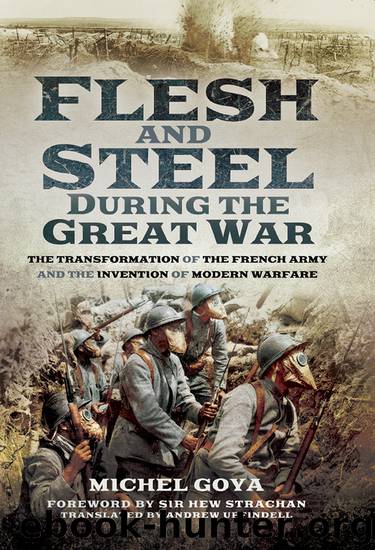
Flesh and Steel During the Great War by Michel Goya & Hew Strachan & Andrew Uffindell
Author:Michel Goya & Hew Strachan & Andrew Uffindell
Language: eng
Format: epub
Tags: HISTORY / Military / World War I
Publisher: Pen and Sword
Published: 2018-10-29T16:00:00+00:00
The academy of mud
The first phase in the organization of training at the front began in autumn 1914. The temporary lull in the fighting allowed an initial system to be improvised, although it had no real infrastructure and was in immediate contact with the front. This system applied in the first instance to the units of reservists, whose technical and tactical proficiency was deemed a cause for concern. In October, General Dubail, the 1st Army commander, imposed a ‘cascading’ training system on the 2nd Group of Reserve Divisions. General Maurice Joppé, the commander of that Group, was to train his generals, who in turn would train their field officers, and so on. ‘Within each unit, the officers and NCOs will be taught practical theories, so that the training of the troops for combat is run reliably.’33
Other problems arose once the 1914 conscript class – the annual intake of conscripts – was incorporated (received into the regiments) in December. The training given to the young recruits, it was noted, did not match the new realities of combat. When Joffre was informed of these shortcomings, he prescribed an initial series of measures. In particular, he required instructors in ‘cushy’ posts behind the lines to be replaced with wounded or convalescent men who had actually been under fire.
On 26 November, General Dubail gave an order ‘to improve target practice, by having each man – especially young soldiers – fire, in the trenches, six bullets every day at a selected target (an embrasure or loophole in the opposing line) under the supervision of an NCO or qualified senior soldier.’34
The army corps created training units to enable the young conscript classes to learn the know-how of positional warfare. The Third Department of the 1st Army’s staff distributed an instruction to the army corps about infantry tactics, which was to serve as a guide for setting up training programmes. On GHQ’s order, this note was disseminated to the schools outside the theatre of operations.35
In short, the traditional training structure could not meet the new demands of combat. As for the field armies, they were unable to maintain a proper level of training, owing to their manpower problems, the length of the front they had to hold, the construction tasks they had to carry out and the fact that too many of their troops were in the front line, not to mention the absence of suitable training facilities, which had been inadequate even in peacetime. Hence the armies were unable to prevent both men and units from becoming increasingly disparate in their tactical and technical proficiencies. Furthermore, peacetime habits took time to change and so soldiers often found their periods of rest and relaxation a disappointing experience. Many officers protested about this. Lieutenant Roger Campana of the 42nd Infantry Division wrote:
When the men return from the trenches, they need to be able to forget a bit that they are at war ... so they no longer see the haunting vision of death, which has brushed past them and will brush past them again.
Download
This site does not store any files on its server. We only index and link to content provided by other sites. Please contact the content providers to delete copyright contents if any and email us, we'll remove relevant links or contents immediately.
| Africa | Americas |
| Arctic & Antarctica | Asia |
| Australia & Oceania | Europe |
| Middle East | Russia |
| United States | World |
| Ancient Civilizations | Military |
| Historical Study & Educational Resources |
The Radium Girls by Kate Moore(12035)
100 Deadly Skills by Clint Emerson(4931)
Rise and Kill First by Ronen Bergman(4797)
The Templars by Dan Jones(4695)
The Doomsday Machine by Daniel Ellsberg(4493)
The Rape of Nanking by Iris Chang(4224)
Killing England by Bill O'Reilly(4008)
Stalin by Stephen Kotkin(3973)
Hitler in Los Angeles by Steven J. Ross(3949)
12 Strong by Doug Stanton(3554)
Hitler's Monsters by Eric Kurlander(3348)
Blood and Sand by Alex Von Tunzelmann(3207)
The Code Book by Simon Singh(3197)
Darkest Hour by Anthony McCarten(3135)
The Art of War Visualized by Jessica Hagy(3014)
Hitler's Flying Saucers: A Guide to German Flying Discs of the Second World War by Stevens Henry(2759)
Babylon's Ark by Lawrence Anthony(2685)
The Second World Wars by Victor Davis Hanson(2529)
Tobruk by Peter Fitzsimons(2521)
